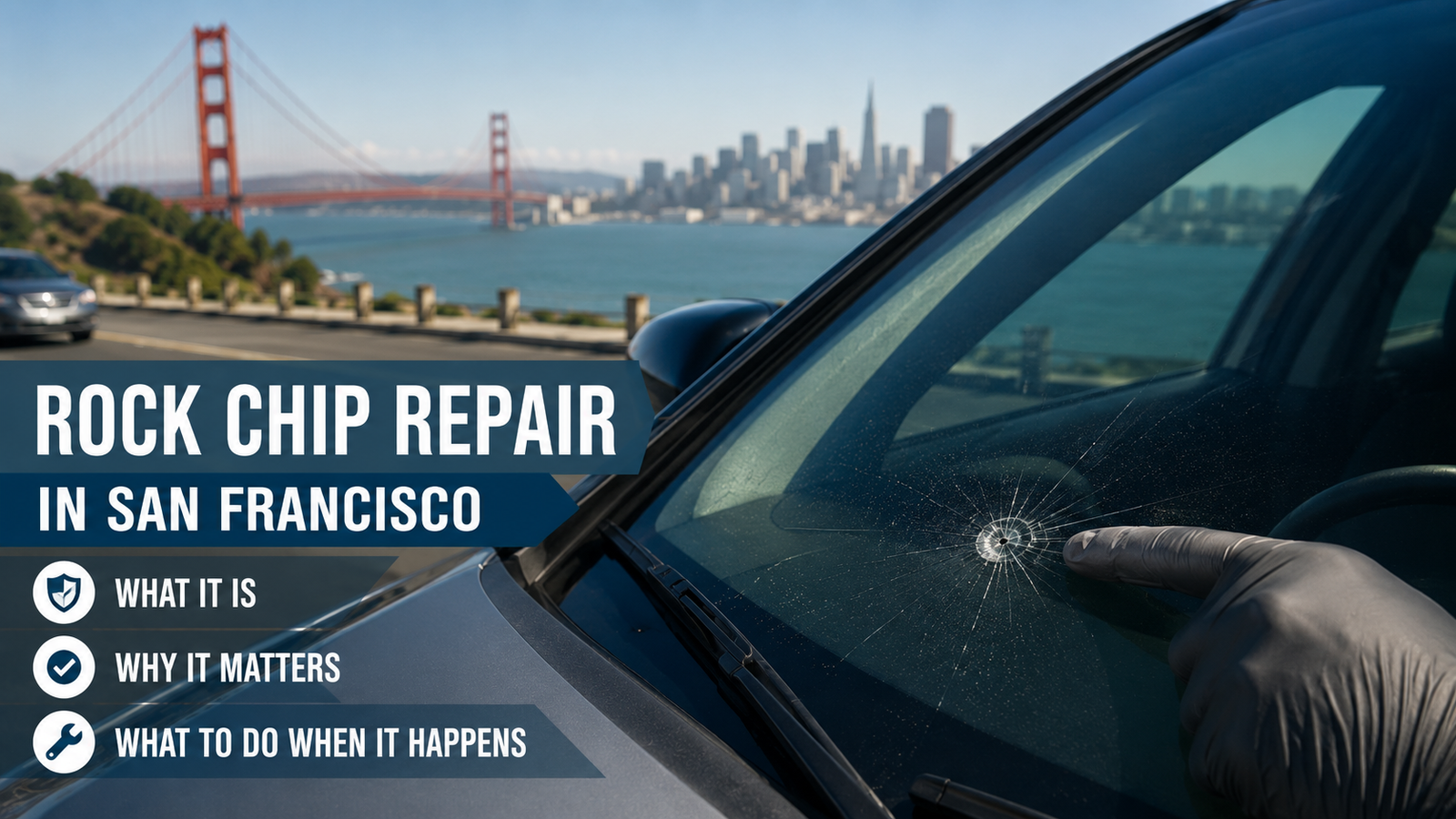
The sound is unmistakable: a sharp crack or thud as a piece of road debris strikes your windshield, followed by the visual confirmation of a new chip or star pattern in the glass. Rock chips are among the most common vehicle damage events in San Francisco a city where heavy construction activity, dense traffic on high-speed corridors, and aging road surfaces create consistent road debris exposure for Bay Area drivers. This guide explains exactly what rock chips are, why addressing them promptly is one of the most practical decisions a San Francisco driver can make, and what the Rock Chip Repair San Francisco process involves.
What Is a Rock Chip?
A rock chip also called a stone chip, windshield chip, or glass chip is a localized impact damage on a vehicle’s windshield caused by a piece of rock, gravel, stone, or other hard debris striking the glass at speed. The impact creates a point of damage where the glass has been fractured, displaced, or excavated, leaving a void in the outer layer of the windshield’s laminated glass structure.
Rock chips take several distinct shapes depending on the size, shape, and angle of the impacting material and the speed of impact. A bullseye chip is a circular impact with a clear dark center point and a concentric ring around it this shape occurs when a rounded object strikes the glass perpendicularly. A star break has a central impact point with radiating arms extending outward, like the shape of a star. A combination break has both bullseye and star break characteristics. A half-moon or partial bullseye occurs when a similarly shaped object strikes at an angle. Each of these types has specific repair considerations, and an experienced technician assesses the specific type as part of evaluating repairability.
Why San Francisco Drivers See More Rock Chips Than Average
Several characteristics of driving in San Francisco create above-average rock chip exposure. The city’s construction activity is intense and ongoing major development projects in SOMA, the Mission, Dogpatch, and the Central Waterfront regularly involve trucks carrying aggregate, concrete, and other materials that can shed debris onto roads. Construction zones with loose gravel or improperly contained material are significant chip sources.
San Francisco’s freeway network particularly Highway 101 through the city and the approaches to the Bay Bridge carries heavy truck traffic that dislodges and throws road debris at vehicles following behind. The combination of high speeds on these corridors and the presence of commercial vehicles makes freeway driving in San Francisco a primary chip-generating scenario.
The city’s aging road surface in some neighborhoods also contributes. Areas where road repairs have exposed aggregate at the surface, where patching has introduced loose material, or where road surfaces are deteriorated provide more debris for traffic to dislodge and throw. The San Francisco Bay Area’s construction boom has meant significant road reconstruction activity throughout the region, and active construction zones are consistent sources of rock chip damage.
The Rock Chip Repair Process in Detail
Professional rock chip repair in San Francisco uses a specialized injector tool and high-quality optical resin to fill the chip and restore the windshield’s integrity. The process begins with a thorough assessment of the chip its size, type, depth, and location. The technician determines whether the chip is within repairable limits (generally chips smaller than about one inch in diameter that have not penetrated through both glass layers) and whether any factors location in the driver’s line of sight, proximity to the edge, existing crack propagation from the chip affect the repair decision.
If the chip is repairable, the technician begins by thoroughly cleaning and drying the chip area. Any moisture, dirt, or loose glass fragments within the chip void must be removed, as contamination will compromise the resin bond. A specialized vacuum/pressure injector is then attached over the chip using a flexible mounting fixture. The tool alternately applies vacuum (to remove air from the chip void) and pressure (to force resin into all the micro-fractures within the damage). This injection cycle is repeated until the resin has fully penetrated all areas of the chip.
After injection, excess resin is removed from the glass surface and the injector is replaced with a finishing pit fill. A small amount of resin is applied to the surface of the pit and covered with a UV film. The resin is then cured under UV light either from a UV lamp or from direct sunlight which causes the resin to harden to a clear, stable state. After curing, the film is removed, the surface is polished, and the repair is complete.
The total time for a standard rock chip repair is typically 20 to 30 minutes. Mobile service a technician who comes to your location anywhere in San Francisco means the repair can be done at your home, your office, or wherever the vehicle is conveniently parked, without needing to drive to a shop.
What Happens If a Rock Chip Is Left Unrepaired
A rock chip that is ignored does not stay static. Several forces work on the damaged area over time to cause the chip to expand into a crack. Thermal cycling the daily expansion and contraction of the glass as temperatures change creates stress at the edges of the chip void where the glass structure has already been disrupted. Each cycle can propagate the damage slightly, and over time what began as a small chip becomes an extending crack.
In San Francisco, the Bay’s marine influence creates a pattern of cool mornings and warmer afternoons that drives regular thermal cycling even without dramatic temperature swings. The city’s fog can introduce moisture into the chip void, and even small amounts of water freezing and expanding during unusually cold nights or simply expanding and contracting with temperature changes in a liquid state can push chip damage outward.
Vibration from driving over San Francisco’s notoriously varied road surfaces the smooth stretches of new pavement alternating with older rough sections, the cable car tracks, the areas of uneven pavement near rail crossings all transmit vibration through the vehicle structure and into the windshield. Vibration energy concentrates at stress points in the glass, and an existing chip is precisely such a stress point.
Once a rock chip has propagated into a crack longer than about three inches, repair is no longer viable and windshield replacement becomes necessary. In practical terms for San Francisco drivers, this means that the cost of ignoring a $0-to-small-deductible chip repair today is potentially a $500-to-$1,500+ windshield replacement tomorrow and for newer vehicles with ADAS cameras, the additional cost of recalibration on top of that.
California Insurance Coverage for Rock Chip Repair
Rock chip repair in San Francisco is typically covered under comprehensive auto insurance. California does not mandate zero-deductible glass coverage, but many California insurance policies and insurers specifically waive the deductible for chip repairs. This means that for many San Francisco drivers, rock chip repair is available at no out-of-pocket cost through their comprehensive coverage making prompt repair even more accessible.
The practical implication is significant: a chip that is repaired under insurance with a waived deductible costs the driver nothing, while a chip left until it propagates into a crack that requires replacement will trigger the full comprehensive deductible which in California typically ranges from $250 to $500 or more depending on the policy. Checking your insurance coverage before a chip repair is a few minutes well spent.
Frequently Asked Questions About Rock Chip Repair in San Francisco
How quickly should I get a rock chip repaired in San Francisco? As soon as possible ideally within the first few days of the damage occurring. The longer a chip sits unrepaired, the more thermal cycling, vibration, and moisture exposure it accumulates, all of which accelerate propagation into a crack. Same-day or next-day service from a mobile auto glass technician is the ideal approach.
Can I drive with a rock chip before getting it repaired? You can drive with a small chip for a short time while arranging repair, but you should avoid car washes (water pressure can accelerate crack propagation), temperature extremes, and rough roads when possible. Do not delay more than a few days if you want to keep the repair option available.
Does rock chip repair leave a visible mark? A quality repair performed by an experienced technician using high-grade resin significantly reduces or eliminates the visual impact of the chip in normal viewing conditions. From the driver’s perspective, looking through the glass while driving, a properly repaired chip is typically not noticeable. At close inspection in specific lighting conditions, a slight optical variation may be visible, but the dark void of an unrepaired chip is eliminated.